Sailgene Technology

 WhatsApp
 service@sailgene.com
Introduction
Spatial transcriptomics involves the use of Nanopore long-read sequencing technology to directly obtain data from Stereo-seq or 10X Visium HD 3', which provides spatially resolved information about full-length cDNA. By analyzing each spot, one can determine the results of isoform quantification and variable splicing events. It not only enables the identification of all RNA molecules but also retains the original positioning information within the tissue section. This is crucial for understanding the spatial distribution of gene expression, as the relationships within and between cells are significant.
Applications

Tumor research

Brain science research

Embryonic development

Immunology
Highlights

Spatially specific isoforms

Differential isoform variation

Isoform exchange in different regions
Workflow


Sample QC


Library QC


Data QC


Bioinformatics Analysis
Refer to the demo results
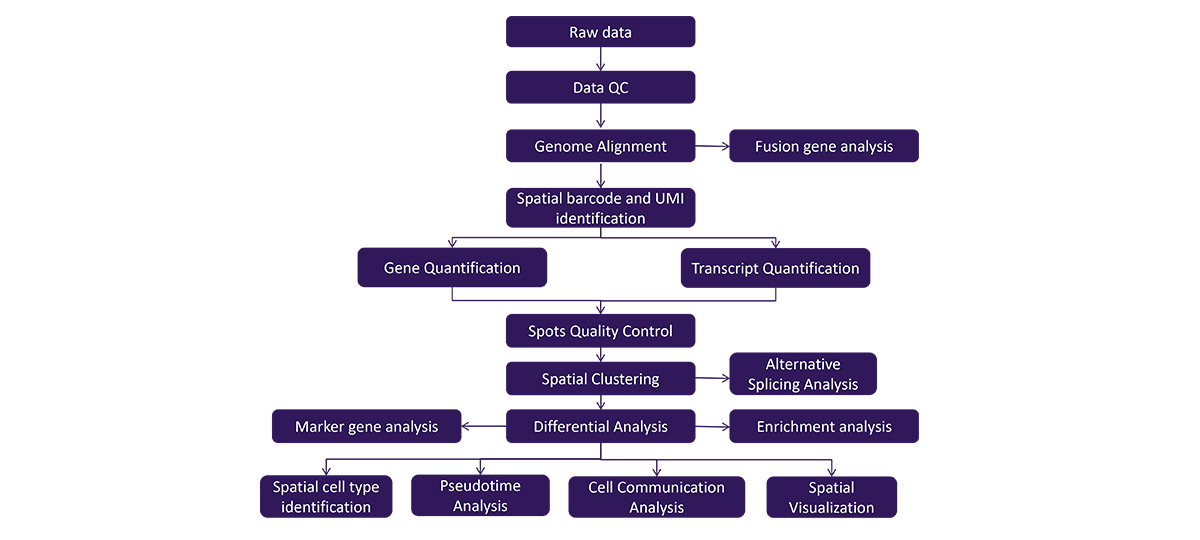
Analysis Workflow
Data Delivery File Formats
Fastq Data Files
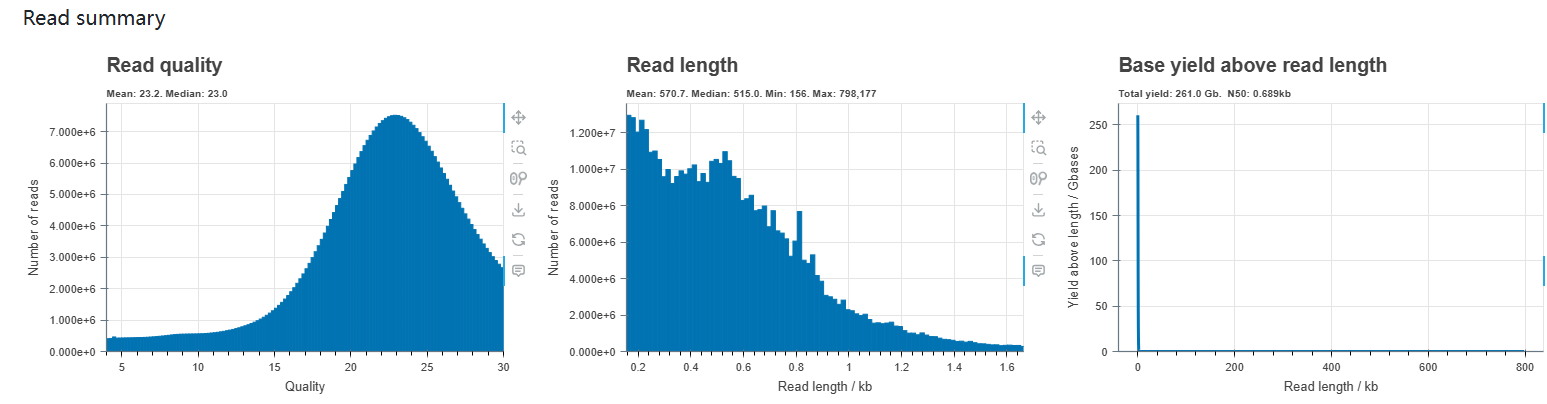
Sequencing Yield Display
Sample Requirements
|
Sample Type |
Platform |
Sample Collection |
Transportation |
|
OTC |
Visium HD |
Ensure that fresh tissues are embedded in OCT within 30 minutes after ex vivo isolation. Length × Width: ≤ 6.5 mm × 6.5 mm; Height: ≥ 5 mm Mark the cut surface with an asterisk (*) or the label "Cut Surface". Stored at -80℃. |
Pack the sorted samples and embed them in dry ice and send it out as soon as possible. Ensure sufficient dry ice is used. |
|
Stereo-seq |
Ensure that fresh tissues are embedded in OCT within 30 minutes after ex vivo isolation. The maximum size of the tissue cut surface shall not exceed 0.9 times the chip size. The thickness of the embedded block shall be controlled within 2 cm. Mark the cut surface with an asterisk (*) or the label "Cut Surface". Stored at -80℃. |
||
|
FFPE |
Visium HD |
The recommended thickness of paraffin blocks is 2–5 mm. Length × Width: ≤ 6.5 mm × 6.5 mm; Height: ≥ 5 mm Mark the cut surface with an asterisk (*) or the label "Cut Surface". Store at room temperature or 4℃. |
Fix the samples in sample boxes to avoid squeezing the surfaces of paraffin blocks or glass slides, and transport them at 4℃ or room temperature. |
|
Stereo-seq |
The maximum size of the tissue cut surface shall not exceed 0.9 times the chip size. The thickness of the embedded block shall be controlled within 2 cm. Mark the cut surface with an asterisk (*) or the label "Cut Surface". Store at room temperature or 4℃. |
Publications
| Year | Journal |
Impact Factor |
Title |
| 2025 | Nature Communications | 15.7 | A spatial long-read approach at near-singlecell resolution reveals developmental regulation of splicing and polyadenylation sites in distinct cortical layers and cell types |
| 2025 | bioRxiv | / | Spatial isoform sequencing at sub-micrometer single-cell resolution reveals novel patterns of spatial isoform variability in brain cell types. |
| 2023 | Nucleic Acids Research | 13.1 | The spatial landscape of gene expression isoforms in tissue sections. |
| 2023 | Nature Communications | 15.7 | Spatial transcriptomics reveals niche-specific enrichment and vulnerabilities of radial glial stem-like cells in malignant gliomas. |
| 2021 | Nature Communications | 15.7 | A spatially resolved brain region- and cell typespecific isoform atlas of the postnatal mouse brain. |
What's the best choice?
|
Year |
Long-read spatial transcriptome sequencin |
Spatial transcriptome sequencing |
|
Sequencing Technology |
Nanopore PromethION |
Illumina / BGI |
|
Reads Length |
Mean read length ~600 bp |
150bp |
|
Delivery File Format |
Fastq |
Fastq |
|
Analyze Content |
1.Spatial gene expression, spatial clustering, spatial annotation 2.Identification of isoform diversity 3.Isoform quantification 4.Differential transcript analysis for spatial clustering 5.Comparison of gene clustering results with isoform clustering results 6.Identification of spatial subpopulations through differential alternative splicing 7.Isoform switching across spatial locations 8.Identification of fusion genes in spatial regions 9.Identification of lncRNAs in spatial regions |
1.Spatial gene expression, spatial clustering, spatial annotation |
Contact Us
If you are interested in our long-read sequencing services or potential collaboration, please contact us. Our team is ready to support your research with tailored solutions. We also welcome feedback from users to help us improve our services.

Contact Us
Add: One Innovation Drive, Suite B3-406, Worcester, MA 01605, USA
在线客服添加返回顶部
右侧在线客服样式 1,2,3 1
图片alt标题设置: SAILGENE TECHNOLOGY INC.
表单验证提示文本: Content cannot be empty!
循环体没有内容时: Sorry,no matching items were found.
CSS / JS 文件放置地