Sailgene Technology

 WhatsApp
 service@sailgene.com
Introduction
Full-length metagenomic sequencing is a cutting-edge technology that isolates total DNA from microbial communities in specific environments (e.g., soil, water bodies, gut). Leveraging Nanopore sequencing, it generates high-quality complete sequences of the isolated DNA, and through advanced bioinformatics analysis, enables in-depth exploration of the species distribution, community structure, gene functions, and metabolic networks of environmental microorganisms. Notably, this approach facilitates the detection of a broader spectrum of antibiotic resistance genes (ARGs) and multidrug resistance genes (MDRGs), while supporting the assembly of closed, complete bacterial genomes.
Applications

Human Health: Feces, intestinal contents, dental plaque, vaginal secretions, body fluids (e.g., saliva, lavage fluids).

Soil Environments: Farmland, woodland, grassland.

Aquatic Environments: Wastewater, rivers, lakes, oceans.

Extreme Environments: Permafrost, saline lakes, glaciers, volcanic environments.

Other Environments: Plant surfaces, air, bioreactors, synthetic microbial communities.
Product Advantages

Ultra-long read length: The N50 value can reach 3–10 Kb, with the maximum read length exceeding 100 Kb, enabling traversal of long and complex genomic regions.

Accurate functional annotation: Facilitating more precise differential gene analysis and more comprehensive virulence factor analysis.

Precise identification of resistance genes: Supporting the detection of a broader range of antibiotic resistance genes (ARGs) and multidrug resistance genes (MDRGs).

Generation of complete genomes: Enabling the retrieval of species-level, strain-level, and plasmid genomes following binning and assembly.
Preservation of modification information: Retaining base modification information such as N6-methyladenine (6mA) and 5-methylcytosine (5mC).
Workflow


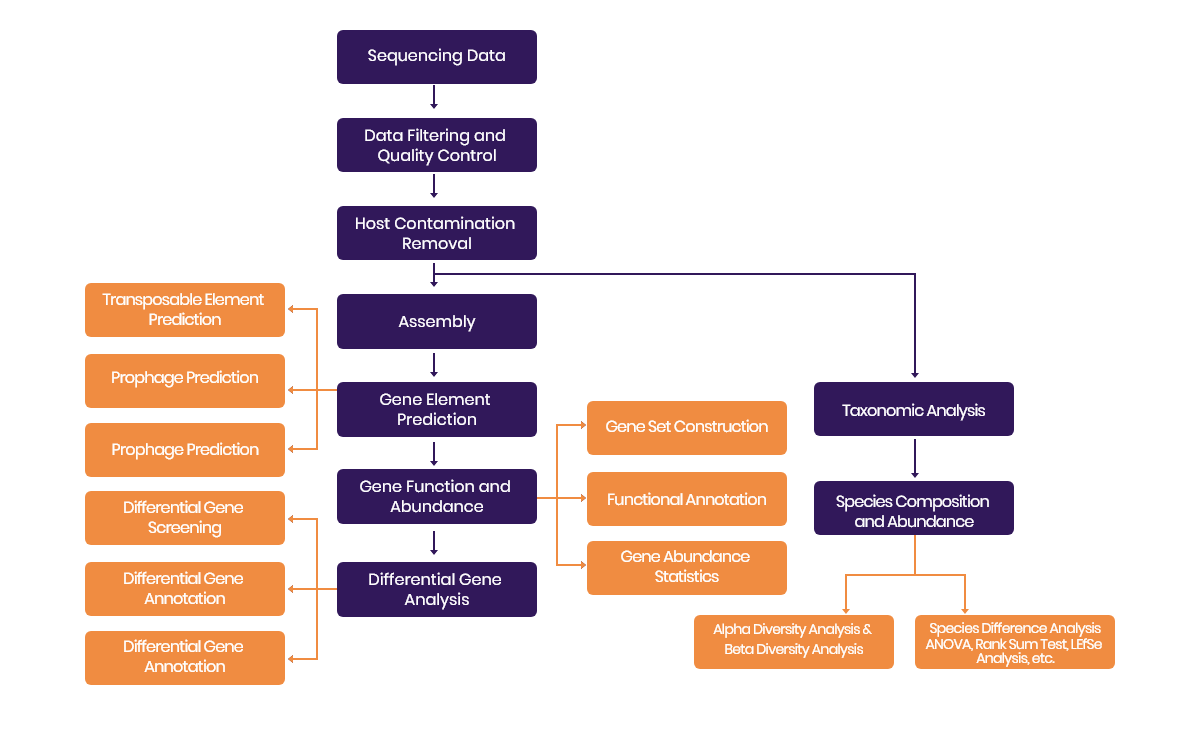
Bioinformatics Analysis
Fast And Comprehensive Bioinformatics Analysis
Analysis Flowchart
Data Delivery Format
FASTQ
Comparison with Other Technologies
| Comparison Dimension | ONT Full-Length Metagenomics | Illumina Short-Read Metagenomics |
| Core Read Length | Tens to hundreds of kilobases (kb), covering complete genes/operons | 150–300 base pairs (bp), covering only gene fragments |
| Assembly Performance | Capable of spanning repetitive sequences/highly similar regions, with 10–100-fold improved assembly contiguity (N50); high-quality Metagenome-Assembled Genomes (MAGs) achievable via hybrid assembly | Severe assembly fragmentation, difficulty in resolving repetitive regions, and poor MAGs completeness |
| Species Resolution | Strain-level precise identification, with full-length 16S rRNA gene coverage enabling accurate differentiation of closely related species | Species-level identification only, with extremely limited ability to distinguish strains |
| Functional Gene Analysis | Directly links functional genes (e.g., Antibiotic Resistance Genes, ARGs; secondary metabolic gene clusters) to host strains, fully capturing tandem functional elements | Fragmented functional gene annotation, inability to determine complete gene cluster structures, and functional-host associations requiring inference |
| other Advantages |
1. Simultaneously acquires genomic sequence and epigenetic modification information (e.g., DNA methylation); 2. Supports PCR-free library preparation, fully preserving the original microbial community structure; 3. Portable equipment compatible with on-site emergency sequencing |
High throughput and low per-base sequencing cost; |
Article Case:
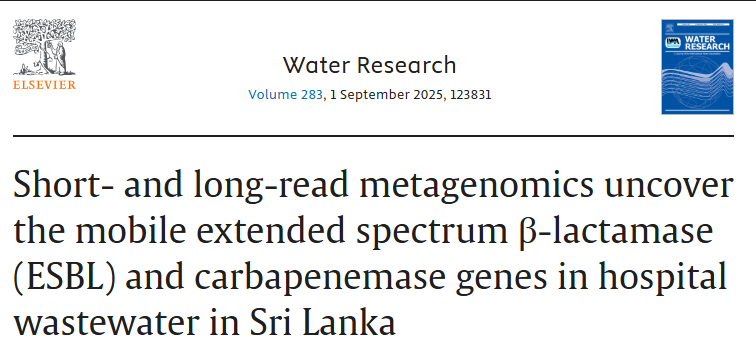
Short- and long-read metagenomics uncover the mobile extended spectrum
β-lactamase (ESBL) and carbapenemase genes in hospital wastewater in Sri Lanka
Publication Date: May 15, 2025
Journal & Impact Factor: Water Research; 11.5
DOI: 10.1016/j.watres.2025.123831
Citation: Guruge SK, Han Z, Karunaratne SHPP, Chandrajith R, Cooray T, Hu C, Zhang Y, Yang M. Short- and long-read metagenomics uncover the mobile extended spectrum β-lactamase (ESBL) and carbapenemase genes in hospital wastewater in Sri Lanka. Water Res. 2025 Sep 1;283:123831.
Sample Submission Requirements
Full-Length Metagenomics Specifications:
DNA Sample Requirements
|
Library Type |
Sample Type |
Amount |
Volume |
Concentration |
Purity (NanoDropTM/Agarose Gel) |
|
Full-Length Metagenomics |
Total DNA |
≥1 μg |
≥50 μL |
≥20 ng/μL |
OD260/280≥1.5 NC/QC=0.95~1.5 no degradation no contamination |
Other types of samples can be consulted with the application scientist
Contact Us
If you are interested in our long-read sequencing services or potential collaboration, please contact us. Our team is ready to support your research with tailored solutions. We also welcome feedback from users to help us improve our services.

Contact Us
Add: One Innovation Drive, Suite B3-406, Worcester, MA 01605, USA
在线客服添加返回顶部
右侧在线客服样式 1,2,3 1
图片alt标题设置: SAILGENE TECHNOLOGY INC.
表单验证提示文本: Content cannot be empty!
循环体没有内容时: Sorry,no matching items were found.
CSS / JS 文件放置地